Table of Contents
Understanding Bartlett’s Test of Sphericity
The Bartlett’s Test of Sphericity is a fundamental statistical procedure used in multivariate analysis. Its primary function is to assess whether the observed correlation matrix of a set of variables differs significantly from the identity matrix. In essence, the test determines if the variables in the dataset are sufficiently related, or redundant, such that they can be effectively summarized by a smaller number of underlying factors or components.
When we analyze complex datasets with numerous variables, we often seek methods to reduce dimensionality without losing critical information. Bartlett’s test provides a crucial preliminary check, establishing whether a data reduction technique is even viable. If the variables show minimal correlation with one another, attempting to compress them into fewer factors would be statistically futile, as there is no shared variance to capture.
The core premise is to identify whether significant structure exists within the data. A successful test indicates that the measured variables possess sufficient interdependence, suggesting that these relationships can be mathematically modeled and condensed. This preliminary step ensures that subsequent, resource-intensive analyses, such as factor extraction, are justified and likely to yield meaningful results.
Note: Bartlett’s Test of Sphericity is not the same as . This distinction is vital, as the similar terminology often leads to confusion regarding their application contexts in statistical modeling.
The Hypotheses Driving the Sphericity Test
Understanding the formal hypotheses is essential for interpreting the results of Bartlett’s Test. Like all inferential statistical tests, it operates based on a null hypothesis ($H_0$) and an alternative hypothesis ($H_a$).
The Null Hypothesis ($H_0$) postulates that the population correlation matrix is equal to the identity matrix. Statistically, this means that the variables are orthogonal—perfectly uncorrelated—and therefore statistically independent. If this hypothesis were true, any observed correlations would merely be due to sampling error, and there would be no underlying structure or redundancy among the variables.
Conversely, the Alternative Hypothesis ($H_a$) states that the population correlation matrix is not equal to the identity matrix. This implies that the variables are sufficiently correlated such that the correlation structure diverges significantly from that of independence. Rejecting the null hypothesis in favor of the alternative provides statistical evidence that the variables share common variance, making them suitable candidates for dimensionality reduction.
Distinguishing Correlation Matrix from Identity Matrix
To fully appreciate the test, one must visualize the matrices being compared. A correlation matrix is a square matrix that summarizes the pairwise correlation coefficients between all variables in a dataset. Each cell in the matrix represents the correlation (ranging from -1 to 1) between two specific variables.
For instance, consider the following example, which illustrates the correlation coefficients among several performance metrics for professional basketball teams:
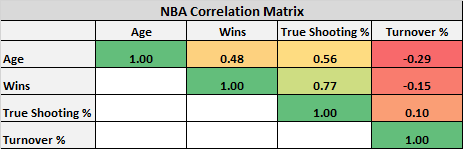
The correlation coefficient itself can vary from -1 (perfect negative correlation) to 1 (perfect positive correlation). Coefficients closer to 0 indicate weaker linear relationships. In a typical correlation matrix, the diagonal elements are always 1, representing the variable correlated with itself. Bartlett’s test primarily scrutinizes the off-diagonal elements to determine if they are close enough to zero to be considered non-significant.
In contrast, the identity matrix is a specific type of square matrix where all diagonal elements are precisely 1, and every off-diagonal element is exactly 0.
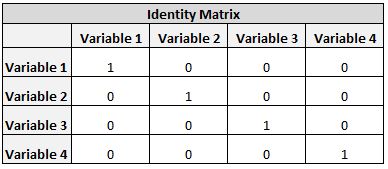
If a correlation matrix perfectly resembled this identity matrix, it would mean that every variable is perfectly uncorrelated (orthogonal) to every other variable. In such a scenario, a data reduction technique would find no meaningful shared variance to “compress,” rendering methods like Principal Component Analysis (PCA) or Factor Analysis ineffective. Therefore, the core objective of Bartlett’s Test of Sphericity is to statistically confirm that our observed correlation matrix diverges significantly from the state of complete independence represented by the identity matrix.
Prerequisites for Data Reduction Techniques
Bartlett’s Test serves as an essential preliminary condition—a gatekeeper—before applying advanced dimensionality reduction methods. It provides the statistical backing needed to justify the application of techniques like PCA or Factor Analysis, which rely on the principle of shared variance among input variables.
If the variables are largely uncorrelated, as hypothesized under the null hypothesis, then attempting to create latent constructs (factors) or linear combinations (principal components) will fail to capture a significant portion of the total variance. The resulting components would simply be highly specific linear combinations of the input variables, offering little interpretative or predictive advantage over the original data.
The decision criterion for suitability is based on the P-value obtained from the test. If the P-value is smaller than the predetermined significance level ($alpha$, often set at 0.10, 0.05, or 0.01), we reject the null hypothesis. Rejecting $H_0$ confirms that the correlation matrix is significantly different from the identity matrix, thereby validating that the dataset contains sufficient intercorrelations to warrant a data reduction approach. Conversely, a high P-value suggests weak or no significant correlation structure, indicating that data reduction is inappropriate.
Practical Implementation in R
To execute Bartlett’s Test of Sphericity in the R statistical environment, we utilize the cortest.bartlett() function, which is contained within the widely used psych library. This function requires two primary inputs to perform the statistical calculation.
cortest.bartlett(R, n)
- R: This parameter requires the calculated correlation matrix of the dataset’s variables.
- n: This parameter specifies the total sample size (number of observations) used to calculate the correlation matrix.
The following example demonstrates a complete workflow in R, from generating sample data and calculating the correlation structure to applying the Bartlett test and interpreting the output:
#make this example reproducible
set.seed(0)

#create fake data
data <- data.frame(A = rnorm(50, 1, 4), B = rnorm(50, 3, 6), C = rnorm(50, 5, 8))

#view first six rows of data
head(data)
#           A          B           C
#1  6.0518171  4.5968242 11.25487348
#2 -0.3049334  0.7397837 -1.21421297
#3  6.3191971 17.6481878  0.07208074
#4  6.0897173 -1.7720347  5.37264242
#5  2.6585657  2.6707352 -4.04308622
#6 -5.1598002  4.5008479  9.61375026

#find correlation matrix of data
cor_matrix <- cor(data)

#view correlation matrix
cor_matrix

#          A            B            C
#A 1.0000000 0.1600155667 0.2825308511
#B 0.1600156 1.0000000000 0.0005358384
#C 0.2825309 0.0005358384 1.0000000000

#load psych library
library(psych)

#perform Bartlett's Test of Sphericity
cortest.bartlett(cor_matrix, n = nrow(data))

#$chisq
#[1] 5.252329
#
#$p.value
#[1] 0.1542258
#
#$df
#[1] 3
In this example, the test yields a Chi-Square test statistic of 5.252329. Crucially, the corresponding P-value is 0.1542258. If we adopt a standard significance level ($alpha$) of 0.05, we observe that the P-value (0.1542258) is not smaller than 0.05.
Based on this result, we fail to reject the null hypothesis. This statistical outcome suggests that the data is likely not suitable for PCA or Factor Analysis. The variables in this simulated dataset are too weakly correlated; consequently, any effort to compress them into fewer linear combinations would struggle to capture significant variance, leading to a poor fit and potentially misleading results in the subsequent data reduction model.
Cite this article
Mohammed looti (2025). Understanding Bartlett’s Test of Sphericity: A Statistical Method for Assessing Data Redundancy. PSYCHOLOGICAL STATISTICS. Retrieved from https://statistics.arabpsychology.com/a-guide-to-bartletts-test-of-sphericity/
Mohammed looti. "Understanding Bartlett’s Test of Sphericity: A Statistical Method for Assessing Data Redundancy." PSYCHOLOGICAL STATISTICS, 9 Nov. 2025, https://statistics.arabpsychology.com/a-guide-to-bartletts-test-of-sphericity/.
Mohammed looti. "Understanding Bartlett’s Test of Sphericity: A Statistical Method for Assessing Data Redundancy." PSYCHOLOGICAL STATISTICS, 2025. https://statistics.arabpsychology.com/a-guide-to-bartletts-test-of-sphericity/.
Mohammed looti (2025) 'Understanding Bartlett’s Test of Sphericity: A Statistical Method for Assessing Data Redundancy', PSYCHOLOGICAL STATISTICS. Available at: https://statistics.arabpsychology.com/a-guide-to-bartletts-test-of-sphericity/.
[1] Mohammed looti, "Understanding Bartlett’s Test of Sphericity: A Statistical Method for Assessing Data Redundancy," PSYCHOLOGICAL STATISTICS, vol. X, no. Y, ص Z-Z, November, 2025.
Mohammed looti. Understanding Bartlett’s Test of Sphericity: A Statistical Method for Assessing Data Redundancy. PSYCHOLOGICAL STATISTICS. 2025;vol(issue):pages.