Table of Contents
In the field of statistics, the metric known as Sxx is a fundamental measure that quantifies the total sum of squared deviations from the mean value of the variable x. This measurement is indispensable for understanding the dispersion or inherent variability within a dataset, specifically concerning a single independent variable. By quantifying how much individual data points stray from the central tendency, with deviations squared to ensure positive values and amplify larger differences, Sxx provides a robust indication of data spread.
This calculated value holds particular significance in various sophisticated statistical analyses. Most notably, Sxx is a foundational component when constructing a simple linear regression model manually. Understanding the calculation and interpretation of Sxx is an essential prerequisite for determining the relationship between two variables, as it directly serves as the denominator in the calculation of the regression line’s slope.
The primary purpose of calculating Sxx is to allow statisticians and data analysts to precisely quantify the total variation attributable solely to the independent variable, x. This quantitative insight into data spread is not merely descriptive; it is a critical requirement for performing more advanced statistical computations, conducting rigorous hypothesis testing, and ensuring the reliability of predictive models.
The Definitive Formula for Calculating Sxx
To successfully calculate Sxx, analysts utilize a mathematically precise formula designed to systematically capture the squared differences between every data point and the established central measure—the dataset’s mean. This formula is crucial because it aggregates the individual variability into a single, comprehensive value, representing the entire squared variability inherent in the set of x observations.
The standard formula employed to compute Sxx is formally defined as follows:
Sxx = Σ(xi – x)2
A thorough understanding of the formula requires breaking down each component part and clarifying its specific function within the calculation:
- Σ: This represents the Greek capital letter, Sigma, which is the universal mathematical symbol indicating the operation of summation. In the context of Sxx, it instructs us to sum all the resulting squared differences calculated for every observation in the dataset.
- xi: This term designates the ith individual observation or value of the independent variable x. This calculation must be performed iteratively for each data point within your dataset.
- x: Pronounced “x-bar,” this critical symbol represents the arithmetic mean or average of all the x values in the dataset. It serves as the static central reference point against which all individual deviations are measured.
- (xi – x): This parenthetical expression calculates the raw deviation of each individual x value from the mean. The sign of the result indicates whether the observation lies above (positive) or below (negative) the average.
- (xi – x)2: Squaring each deviation accomplishes two mathematically necessary goals. First, it ensures that all calculated values are positive, preventing opposing deviations from neutralizing each other when summed. Second, it applies a greater mathematical weight to larger deviations, accurately reflecting their more pronounced contribution to the overall spread and variance.
Step-by-Step Example: Manual Calculation of Sxx
To clearly illustrate the practical implementation of the Sxx formula, we will now proceed through a detailed, manual example using a small, controlled dataset. This methodical, step-by-step approach is designed to clarify every stage of the calculation process and solidify your foundational statistical understanding.
Imagine a scenario where we are preparing to fit a simple linear regression model. A critical initial step in this regression analysis is accurately quantifying the variability of the independent variable, x. For this calculation, we will use the following observations for x:
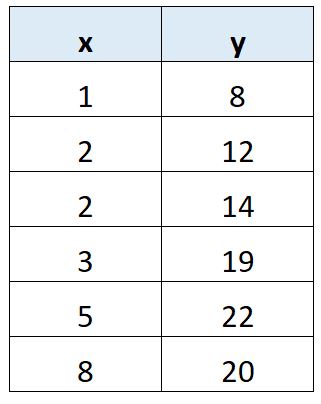
Our objective remains to calculate Sxx, which represents the sum of squared deviations of the x values from their mean.
Step 1: Calculate the Arithmetic Mean of x (x)
The foundational first step in computing Sxx is to accurately determine the mean of all the x values within our dataset. Establishing this central reference point is necessary before we can measure the distances of individual points from it. We sum the observations and divide by the count (N=6):
- x = (1 + 2 + 2 + 3 + 5 + 8) / 6 = 3.5
The calculated arithmetic mean of our x values is determined to be 3.5. This precise value will be the constant subtracted from every individual x observation in the subsequent step to find the deviation.
Step 2: Determine Deviations from the Mean (xi – x)
Next, for every observation in the dataset, we execute the subtraction of the calculated mean (3.5) to isolate its specific deviation. This step is crucial as it reveals both the magnitude and direction (positive or negative) of the distance between each point and the dataset’s center.
- (1 – 3.5) = -2.5
- (2 – 3.5) = -1.5
- (2 – 3.5) = -1.5
- (3 – 3.5) = -0.5
- (5 – 3.5) = 1.5
- (8 – 3.5) = 4.5
Step 3: Square Each Deviation ((xi – x)2)
Following the calculation of deviations, the next crucial requirement of the Sxx formula is to square each of these differences. Squaring serves to eliminate the negative signs associated with observations below the mean, and, more importantly, it emphasizes the impact of outlying data points, ensuring that larger deviations contribute proportionally more to the final variability score.
- (-2.5)2 = 6.25
- (-1.5)2 = 2.25
- (-1.5)2 = 2.25
- (-0.5)2 = 0.25
- (1.5)2 = 2.25
- (4.5)2 = 20.25
Step 4: Sum the Squared Deviations (Σ(xi – x)2)
The final step is the summation (represented by Sigma) of all the squared deviations computed in Step 3. This aggregated total constitutes the value of Sxx, providing the quantitative measure of the total squared variability inherent in the independent variable x.
- Sxx = 6.25 + 2.25 + 2.25 + 0.25 + 2.25 + 20.25
- Sxx = 33.5
Consequently, the calculated value for Sxx is confirmed as 33.5. This figure definitively quantifies the total sum of squared deviations between the individual x observations and their arithmetic average.
Verifying Calculations with Specialized Statistical Tools
While manual calculation is essential for grasping the underlying statistical mechanics, it is always best practice to verify the results using a reliable statistical calculator or specialized software. This verification step is critical for confirming the numerical accuracy of your computations, mitigating the risk of human error, and strengthening confidence in your analytical results.
By employing a dedicated statistical calculator designed specifically for linear regression analysis parameters, we input our initial x values (1, 2, 2, 3, 5, 8). The software then automatically executes the entire multi-step process: finding the mean, determining individual deviations, squaring those deviations, and summing the results.

As the visual confirmation above demonstrates, the statistical tool returns a value of 33.5 for Sxx. This result is in perfect agreement with the value we meticulously derived by hand, thus validating our manual computation and reinforcing the comprehension of both the formula and its practical application.
Sxx’s Critical Role in Simple Linear Regression
The measurement of Sxx is particularly critical within the methodological framework of simple linear regression (SLR). SLR is a powerful statistical technique used to formally model the linear relationship observed between two variables: x, designated as the independent or predictor variable, and y, the dependent or response variable. The core objective of SLR is to determine the “best-fitting” straight line that accurately describes this relationship, enabling reliable prediction and statistical inference.
The standard mathematical equation representing this regression line is expressed as:
y = a + bx
Each element of this equation fulfills a specific statistical function:
- y: Represents the predicted value of the dependent variable.
- a: Denotes the y-intercept, which is the predicted value of y when the predictor variable x is equal to zero.
- b: Represents the slope of the regression line, quantifying the average rate of change in y corresponding to a single unit increase in x.
- x: Refers to the measured value of the independent variable.
To calculate the precise values for the intercept (‘a’) and the slope (‘b’)—which define the best-fit line based on the least squares criterion—specific formulas are applied. It is within the formula for the slope that Sxx plays a direct and indispensable role:
- a = y – bx
- b = Sxy / Sxx
As clearly demonstrated by the formula for ‘b’, Sxx occupies the denominator. This structural placement means that Sxx acts as a standardizing factor; it quantifies the total dispersion in the independent variable, which is then used to scale the covariance between x and y (represented by Sxy) to derive the precise slope. A high Sxx value indicates greater spread in the x data points, which generally contributes to a more reliable and stable estimate of the slope, assuming the relationship itself is strong.
Beyond Regression: The Broader Importance of Squared Deviations
Although Sxx is prominently utilized in simple linear regression, the fundamental statistical concept it embodies—the sum of squared deviations—is a cornerstone that extends far beyond this specific modeling technique. This principle provides a foundational and robust methodology for measuring total variability or dispersion across nearly all areas of modern statistics.
For example, the mechanism of summing squared deviations is central to defining and calculating key descriptive statistics, such as the variance and the standard deviation. These metrics are essential for characterizing the spread and distribution of any given dataset. Furthermore, this principle underpins more complex inferential methodologies like Analysis of Variance (ANOVA), where the total variation observed in the data must first be systematically partitioned into components attributable to different sources to test hypotheses regarding group means.
Consequently, mastering the calculation of Sxx equips the analyst with a powerful, generalizable statistical tool. This foundational knowledge is applicable across a vast spectrum of data analysis tasks, ranging from basic descriptive statistics and data characterization to advanced inferential modeling and the development of sophisticated machine learning algorithms.
Additional Resources for Advanced Statistical Learning
The accurate calculation of Sxx is only one necessary step among many in conducting thorough statistical analyses, particularly when developing predictive models like simple linear regression. To ensure comprehensive statistical proficiency, it is highly recommended to continue exploring related concepts and interdependent calculations that measure relationships and variability.
Expanding your knowledge base to include calculations like Sxy (sum of products of deviations) and Syy (sum of squared deviations for the y variable) will provide a more complete picture of bivariate relationships. These tutorials explain how to perform other common tasks in statistics, building directly upon the foundational understanding of variation and its measurement:
Cite this article
Mohammed looti (2026). Understanding Sxx: Calculating Sum of Squares in Statistics. PSYCHOLOGICAL STATISTICS. Retrieved from https://statistics.arabpsychology.com/calculate-sxx-in-statistics-with-example/
Mohammed looti. "Understanding Sxx: Calculating Sum of Squares in Statistics." PSYCHOLOGICAL STATISTICS, 18 Apr. 2026, https://statistics.arabpsychology.com/calculate-sxx-in-statistics-with-example/.
Mohammed looti. "Understanding Sxx: Calculating Sum of Squares in Statistics." PSYCHOLOGICAL STATISTICS, 2026. https://statistics.arabpsychology.com/calculate-sxx-in-statistics-with-example/.
Mohammed looti (2026) 'Understanding Sxx: Calculating Sum of Squares in Statistics', PSYCHOLOGICAL STATISTICS. Available at: https://statistics.arabpsychology.com/calculate-sxx-in-statistics-with-example/.
[1] Mohammed looti, "Understanding Sxx: Calculating Sum of Squares in Statistics," PSYCHOLOGICAL STATISTICS, vol. X, no. Y, ص Z-Z, April, 2026.
Mohammed looti. Understanding Sxx: Calculating Sum of Squares in Statistics. PSYCHOLOGICAL STATISTICS. 2026;vol(issue):pages.