Table of Contents
The One-Way Analysis of Variance (ANOVA) is an indispensable statistical technique utilized primarily to determine if there are statistically significant differences among the means of three or more independent, unrelated groups. This powerful method serves as a critical extension of the two-sample t-test, enabling researchers to efficiently evaluate multiple groups simultaneously while strictly controlling the overall risk of committing a Type I error. A significant result from the ANOVA test indicates that the means of the populations represented by the samples are not all identical, suggesting that the independent variable (the grouping factor) exerts a measurable influence on the outcome.
This comprehensive tutorial is designed to provide you with a deep understanding of the one-way ANOVA, progressing from its theoretical foundation and necessity to its hands-on application and interpretation.
- Exploring the statistical necessity and underlying motivation for employing the one-way ANOVA framework.
- Identifying, understanding, and verifying the essential statistical assumptions required for the test’s inferences to remain valid.
- Detailing the step-by-step procedure for setting up formal hypotheses and meticulously interpreting the resulting ANOVA summary table.
- Walking through a practical and detailed example to demonstrate both the calculation process and the structure of the final conclusion.
Motivation: Why We Need the One-Way ANOVA
When statistical analysis requires comparing only two distinct group means, the standard independent samples t-test is the most appropriate and efficient tool. However, the analytical complexity escalates significantly when researchers must compare the means of three or more groups. If a researcher were to attempt this comparison using multiple, separate pairwise t-tests (e.g., comparing Group 1 vs. Group 2, Group 1 vs. Group 3, and Group 2 vs. Group 3), they would encounter a major statistical hurdle known as the inflation of the Type I error rate, or the Family-wise Error Rate (FWER). This occurs because every individual test carries an inherent risk (typically 5% or α = 0.05) of incorrectly rejecting the true null hypothesis (a false positive).
By performing multiple comparisons without proper adjustment, the cumulative probability of committing at least one Type I error across the entire set of comparisons rises sharply, often far exceeding the intended 5% threshold. For example, comparing three groups using three t-tests pushes the true FWER considerably higher. The one-way ANOVA offers an elegant and robust solution to this issue. It conducts a single, omnibus test that assesses whether any difference exists among the group population means, thereby holding the overall Type I error rate constant at the designated alpha level, regardless of the number of groups being compared.
Consider a research design aimed at evaluating the effectiveness of three unique exam preparation programs (A, B, and C) on student performance in a standardized test. Since analyzing the entire population is infeasible, we rely on drawing independent samples to represent these larger groups. We might recruit 300 students, randomly assigning 100 to each program, and then record their final exam scores.
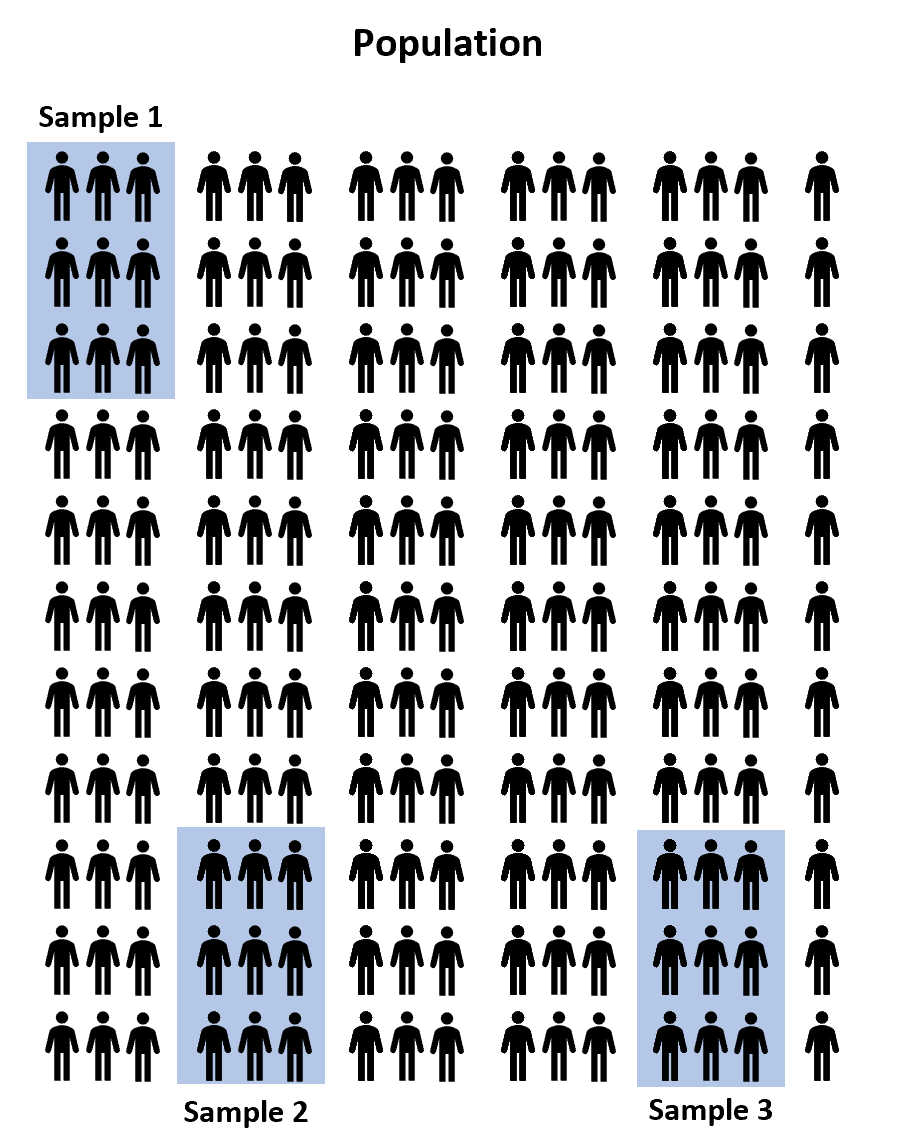
It is expected that the sample mean scores will inevitably differ slightly due to natural, random sampling variability, even if the underlying population programs have identical effects. The central question that ANOVA is designed to answer is whether the observed variation between the group means is sufficiently large, relative to the natural variation that exists within the groups, to be declared statistically significant. Fundamentally, ANOVA works by partitioning the total variability observed in the dataset into two distinct components: the variation explained by the differences between the group treatments and the residual variation attributed to random error.
Prerequisites and Assumptions for a Valid ANOVA Test
For the conclusions drawn from a one-way ANOVA to be accurate, reliable, and valid, the underlying data structure must satisfy several core statistical assumptions. Failure to rigorously check and address violations of these assumptions can lead to a distorted F-statistic and potentially misleading inferences about the true population means.
The following are the fundamental prerequisites that must be confirmed before proceeding with any one-way ANOVA analysis:
1. Normality: The dependent variable scores within each sample group must be drawn from a population that is approximately normally distributed. While ANOVA is generally considered robust against minor deviations from normality, particularly when sample sizes are large (n > 30 per group), severe departures such as extreme skewness or heavy tails can compromise the accuracy of the p-values. Researchers commonly assess this assumption visually using Q-Q plots or formally using statistical tests like the Shapiro-Wilk test.
2. Equal Variances (Homoscedasticity): This assumption, known as homogeneity of variances, demands that the variances of the populations from which the groups are sampled must be roughly equivalent. This condition is crucial because the F-statistic relies on pooling these variances to estimate the error term. Substantial heterogeneity of variances across groups, particularly when combined with unequal sample sizes, can severely inflate or deflate the Type I error rate. To verify this, formal tests such as Levene’s test or Bartlett’s test are employed. If variances prove unequal, alternative procedures, such as Welch’s ANOVA, should be considered.
3. Independence of Observations: The data points within and across groups must be independent of one another. This means that the measurement of one subject should not influence the measurement of any other subject. This is arguably the most critical assumption, as non-independence (e.g., measuring the same subject repeatedly over time) necessitates the use of entirely different statistical frameworks, such as Repeated Measures ANOVA. Ensuring a rigorous, random sampling and assignment procedure in the research design is essential for meeting this prerequisite.
If any of these assumptions are severely violated—especially independence or homogeneity of variances when group sizes differ—researchers should strongly consider employing nonparametric alternatives, such as the Kruskal-Wallis H Test, which do not rely on restrictive parametric distributional assumptions.
The Formal Hypothesis Testing Framework
The one-way ANOVA rigorously adheres to the standard statistical hypothesis testing procedure, establishing competing claims regarding the true population means. These hypotheses provide the interpretive framework necessary for evaluating the F-statistic generated by the analysis.
The framework is structured as follows:
- H0 (null hypothesis): μ1 = μ2 = μ3 = … = μk (The grouping factor has no effect; all population means are statistically equivalent.)
- H1 (alternative hypothesis): At least one population mean is different from the others. (The grouping factor has a genuine, significant effect on at least one group.)
The power of ANOVA stems from its calculation of the F-statistic, which is a ratio comparing the variance observed between the groups (explained variability, represented by the Treatment Mean Square, MSR) to the variance observed within the groups (unexplained error, represented by the Error Mean Square, MSE). A large F-ratio suggests that the differences attributed to the treatment are substantially larger than the differences due to random chance, making the rejection of the null hypothesis highly probable.
Standard statistical software packages (R, SPSS, SAS) universally present the results in a unified ANOVA summary table format, which details the sources of variability:
| Source | Sum of Squares (SS) | df | Mean Squares (MS) | F | p |
|---|---|---|---|---|---|
| Treatment | SSR | dfr | MSR | MSR/MSE | Fdfr, dfe |
| Error | SSE | dfe | MSE | ||
| Total | SST | dft |
The crucial components within this table are defined by their relationships to the total variability (SST):
- SSR: Regression Sum of Squares, quantifying the variation attributable to differences between the groups.
- SSE: Error Sum of Squares, quantifying the residual variation within the groups (unexplained error).
- SST: Total Sum of Squares (SST = SSR + SSE).
- dfr: Regression Degrees of Freedom (k-1, where k is the number of groups).
- dfe: Error Degrees of Freedom (n-k, where n is the total number of observations).
- MSR: Regression Mean Square (MSR = SSR/dfr), the estimate of variance explained by the factor.
- MSE: Error Mean Square (MSE = SSE/dfe), the estimate of unexplained residual variance.
- F: The F test statistic (F = MSR/MSE), which is compared against the F-distribution.
- p: The p-value corresponding to the calculated F statistic, representing the probability of observing data as extreme as ours if the null hypothesis were true.
The decision rule is based solely on the p-value: If the p-value is less than the predetermined significance level (typically α = 0.05), the researcher rejects the null hypothesis. This rejection permits the conclusion that there is strong statistical evidence that at least one of the population means differs significantly from the others.
Interpreting Results and the Necessity of Post-Hoc Analysis
While the F-test provided by the one-way ANOVA confirms the overall presence of a statistically significant difference among the groups, it is an omnibus test. Crucially, it does not identify *which* specific pairs of means are driving that difference. For example, if we compared three brands (A, B, and C), a significant F-statistic only tells us that A, B, and C are not all equal, but it might mean A differs from B, or B differs from C, or both.
Therefore, if and only if the F-test yields a significant result (i.e., the null hypothesis is rejected), researchers must proceed with subsequent statistical procedures known as post-hoc tests, or multiple comparisons tests. These tests perform controlled pairwise comparisons designed specifically to maintain the family-wise error rate at the desired alpha level, thereby preventing the inflation of Type I errors that standard t-tests would cause.
Popular choices for post-hoc tests include Tukey’s Honestly Significant Difference (HSD), the Bonferroni correction, and Scheffé’s method. The selection of the appropriate post-hoc test often depends on factors such as whether the variances were assumed equal and whether the sample sizes are balanced. These exploratory tests are only justified after the overall effect has been established by the ANOVA F-test.
Practical Example: Comparing Exam Prep Programs
Let us apply the theoretical principles of the one-way ANOVA to our previous research scenario. We aim to determine if three distinct college exam preparation programs (Program 1, Program 2, and Program 3) result in genuinely different mean scores on a standardized college entrance exam.
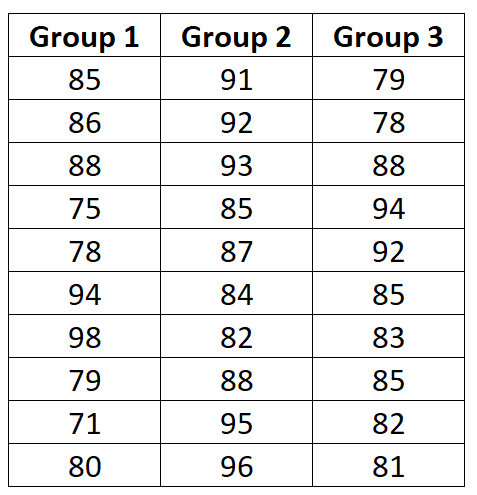
For this simulation, 30 students are recruited and randomly assigned to one of the three programs, yielding 10 students per group. This strict adherence to random assignment is vital for satisfying the assumption of independence of observations. After participating in their assigned programs, all students take the same exam. The recorded scores for each group are summarized below for analysis:
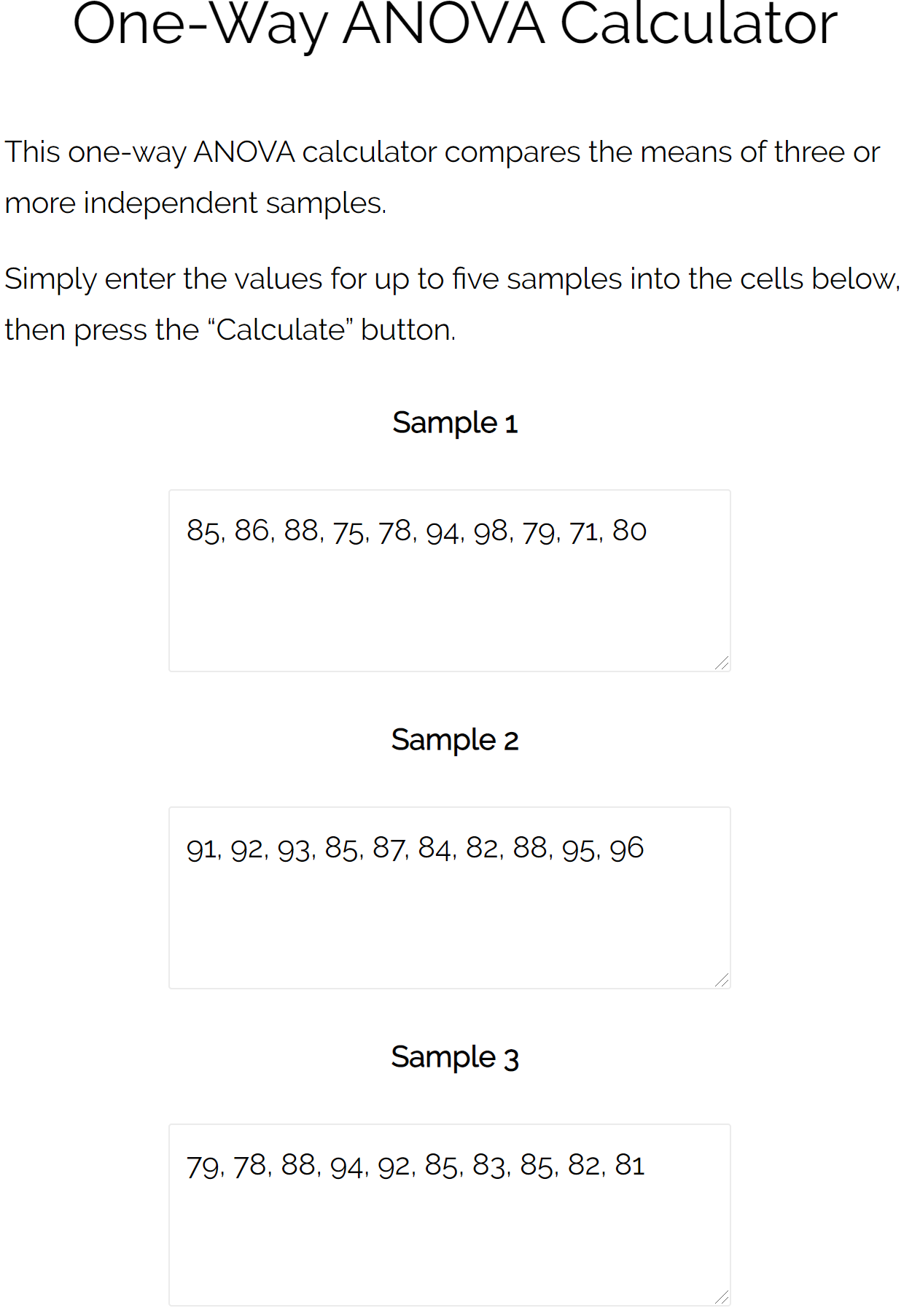
To analyze this dataset, a statistical software package or calculator is used to compute the ANOVA statistics. The input requires the scores to be grouped by their respective programs.
The resulting ANOVA output table provides the necessary F test statistic and the associated p-value, which are key to drawing the final conclusion regarding the hypotheses.
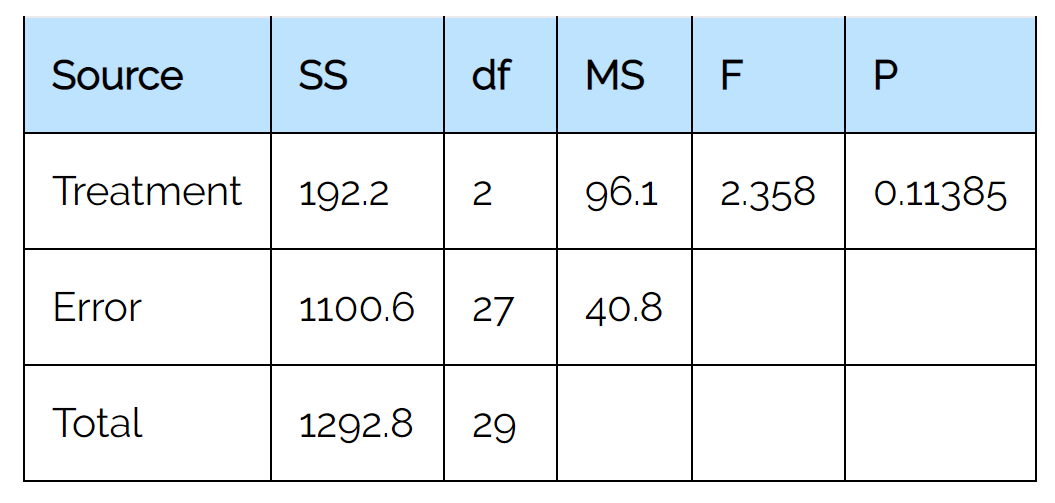
From the output, we observe that the calculated F test statistic is 2.358, and the corresponding p-value is 0.11385. Using the conventional significance level of α = 0.05, we compare the p-value to this threshold. Since 0.11385 is greater than 0.05, we do not have sufficient statistical evidence to reject the null hypothesis (H0).
The formal conclusion is that we fail to assert, at the 0.05 level of significance, that there is a statistically significant difference between the mean exam scores achieved by students across the three different exam preparation programs. Any observed variation in the sample means is likely attributed to random sampling fluctuations rather than a true differential effect caused by the programs themselves.
Additional Resources for Implementation
For students and professional researchers seeking detailed instructions on how to execute the one-way ANOVA using specialized software, the following articles provide step-by-step guidance on data entry, assumption validation, and output interpretation across various statistical platforms:
Cite this article
Mohammed looti (2025). Understanding One-Way ANOVA: A Step-by-Step Guide to Comparing Group Means. PSYCHOLOGICAL STATISTICS. Retrieved from https://statistics.arabpsychology.com/one-way-anova-definition-formula-and-example/
Mohammed looti. "Understanding One-Way ANOVA: A Step-by-Step Guide to Comparing Group Means." PSYCHOLOGICAL STATISTICS, 9 Nov. 2025, https://statistics.arabpsychology.com/one-way-anova-definition-formula-and-example/.
Mohammed looti. "Understanding One-Way ANOVA: A Step-by-Step Guide to Comparing Group Means." PSYCHOLOGICAL STATISTICS, 2025. https://statistics.arabpsychology.com/one-way-anova-definition-formula-and-example/.
Mohammed looti (2025) 'Understanding One-Way ANOVA: A Step-by-Step Guide to Comparing Group Means', PSYCHOLOGICAL STATISTICS. Available at: https://statistics.arabpsychology.com/one-way-anova-definition-formula-and-example/.
[1] Mohammed looti, "Understanding One-Way ANOVA: A Step-by-Step Guide to Comparing Group Means," PSYCHOLOGICAL STATISTICS, vol. X, no. Y, ص Z-Z, November, 2025.
Mohammed looti. Understanding One-Way ANOVA: A Step-by-Step Guide to Comparing Group Means. PSYCHOLOGICAL STATISTICS. 2025;vol(issue):pages.