Table of Contents
Regression analysis serves as a foundational quantitative tool across virtually all scientific and social science disciplines, allowing researchers to systematically model and understand the functional relationship between a dependent variable (the outcome) and one or more independent variables (the predictors). This powerful technique facilitates forecasting, hypothesis testing, and the quantification of complex causal mechanisms based on observed data. The standard approach, known as Ordinary Least Squares (OLS) regression, relies on several key statistical assumptions. A fundamental requirement for valid statistical inference in OLS is homoscedasticity—the condition that the variance of the errors, or residuals, is constant across all levels of the independent variables. When this assumption is systematically violated, the reliability of the statistical conclusions drawn from the model is severely compromised.
The Problem of Heteroscedasticity in Applied Data
In practical data analysis, particularly when dealing with cross-sectional datasets in economics or sociology, the assumption of constant error variance is frequently unrealistic. This violation is termed heteroscedasticity. It manifests when the magnitude of the prediction error systematically changes based on the value of the predictor variables. Essentially, the spread of the residuals is not uniform throughout the dataset. For instance, in a model predicting household consumption, low-income households might exhibit very similar spending patterns (small residual variance), while high-income households might have vastly different spending patterns (large residual variance). This non-uniform spread indicates the presence of heteroscedasticity.
The existence of heteroscedasticity poses a serious threat to standard OLS inference. Crucially, OLS coefficient estimates themselves remain unbiased and consistent, meaning the estimated slopes are still centered around the true population values. However, the calculation of the precision surrounding these estimates becomes fundamentally flawed. Heteroscedasticity generally leads to an increase in the true variance of the coefficient estimates, yet the standard OLS formula fails to recognize this increased uncertainty. Consequently, the calculated standard errors are often underestimated.
Underestimated standard errors result in artificially inflated test statistics, such as the t-statistic. This inflation biases the statistical testing process, making it much easier for the model to declare a predictor variable to be statistically significant when, in reality, the uncertainty surrounding the estimate is much larger. This tendency to commit Type I errors—falsely rejecting the null hypothesis—undermines the entire inferential process and can lead researchers to draw inaccurate or overly confident conclusions. To ensure the credibility of statistical results, this issue must be appropriately addressed.
The Solution: Employing Robust Standard Errors (HCSE)
The most practical and widely accepted method for mitigating the effects of heteroscedasticity without requiring model structure modification is the use of robust standard errors. These errors are also frequently referred to as Heteroscedasticity-Consistent Standard Errors (HCSE) or Huber-White standard errors, named after their creators. They earn the term “robust” because they provide valid estimates of the coefficient variance regardless of the specific, unknown functional form of the heteroscedasticity present in the error term.
Robust standard errors function by adjusting the estimated variance-covariance matrix of the coefficient estimates based directly on the observed pattern of residuals. This crucial adjustment ensures that the calculated uncertainty accurately reflects the true variability of the coefficient estimates, even when the assumption of constant variance is violated. Unlike techniques that require transforming variables or employing generalized least squares (GLS), robust standard errors preserve the original OLS coefficient values while only correcting the inferential statistics. This consistency and simplicity have made them the default choice in fields like applied econometrics and quantitative social science when heteroscedasticity is a concern.
By integrating robust standard errors into the analysis, researchers obtain a more truthful and conservative measure of the true standard error for each regression coefficient. This adjustment usually results in standard errors that are larger than those produced by the standard OLS calculation, leading to smaller absolute t-statistics and, consequently, larger p-values. This conservative approach effectively minimizes the risk of making Type I errors, ensuring that the assessment of statistical significance is reliable. The following tutorial demonstrates the straightforward implementation of this essential adjustment within the powerful statistical software package, Stata.
Setting Up the Stata Demonstration
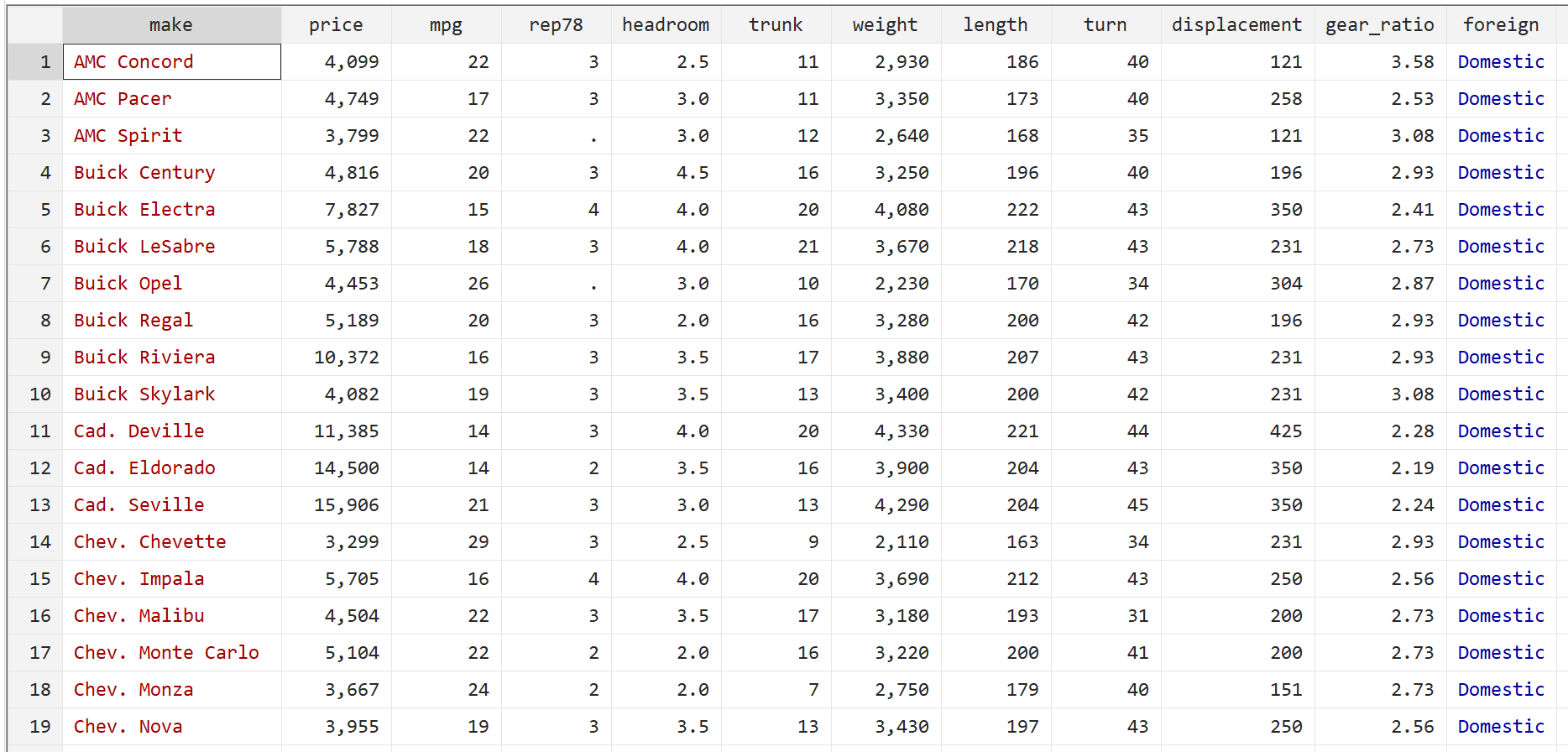
To provide a clear, practical illustration of the effect of robust standard errors, we will use a classic, readily available dataset built into the Stata program: the auto dataset. This dataset is suitable for demonstrating multiple linear regression, containing 74 observations on various vehicle characteristics, including the vehicle’s price, mileage (mpg), and weight. We aim to model price as a function of mileage and weight.
The initial steps involve preparing the working environment and loading the data into the current Stata session. We utilize Stata’s system utility command to retrieve the dataset, followed by a quick command to visually inspect the structure and contents of the newly loaded data.
Step 1: Load and view the data.
First, execute the following command to load the auto dataset, preparing the system for immediate analysis:
sysuse auto
Next, use the `br` command to open the data browser, allowing for a visual review of the variables and observation types to confirm the data is correctly loaded:
br
Establishing the Baseline OLS Model
Before applying any corrections, we must first run a standard OLS regression model. We hypothesize that the vehicle’s price is influenced by its mpg (mileage) and its weight. This initial, uncorrected model will serve as our benchmark, establishing the standard estimates and inferential statistics based on the potentially flawed assumption of homoscedasticity.
For this baseline analysis, we employ the standard Stata regress command, specifying the dependent variable first, followed by the chosen predictors. It is essential to remember that the standard errors calculated in this output are only reliable if the constant variance assumption holds true; otherwise, they may provide an overly optimistic measure of precision.
Step 2: Perform multiple linear regression without robust standard errors.
Execute the following command to perform the multiple linear regression using price as the response variable and mpg and weight as the explanatory variables:
regress price mpg weight
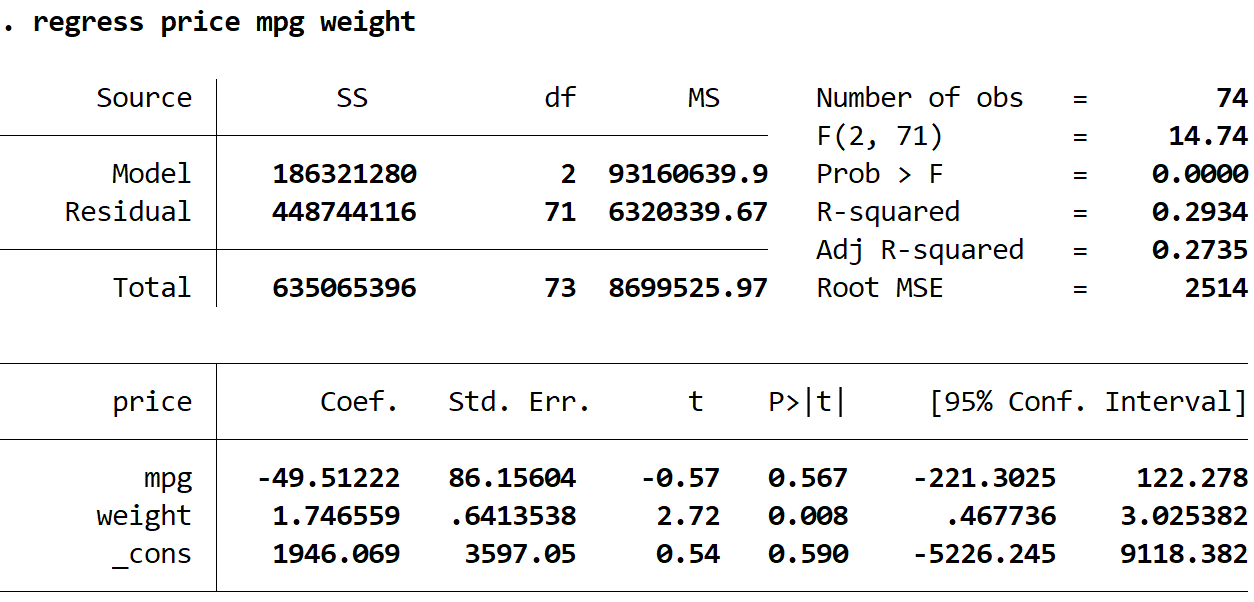
Reviewing this initial output, we obtain the coefficient estimates, their associated standard errors, t-statistics, and p-values. For our comparison, note the specific standard error values for the predictor variables: the standard error for mpg is calculated as approximately 10.97, and the standard error for weight is 0.677. These values represent the precision of the estimates under the assumption of homoscedasticity.
Implementing Robust Standard Errors via the VCE Option
The next critical step is to execute the exact same regression model while explicitly instructing Stata to use the robust, heteroscedasticity-consistent calculation for the standard errors. In Stata, this is achieved by appending the vce(robust) option to the standard regress command. VCE stands for “Variance-Covariance Estimator,” and specifying “robust” invokes the Huber-White adjustment method.
It is important to emphasize that this powerful modification is applied only to the inference stage. The vce(robust) option does not alter the calculation of the regression line itself; the OLS coefficient estimates remain mathematically identical. Instead, it re-calculates the precision metrics, providing a more reliable assessment of uncertainty. By comparing this robust output directly against the baseline OLS output, we can isolate and observe the immediate impact of accounting for potential non-constant error variance on our statistical inferences.
The resulting corrected standard errors offer a more accurate representation of the true uncertainty surrounding the coefficient estimates, thus ensuring that our assessment of statistical significance is protected from the biasing effects inherent in heteroscedastic errors.
Now we will perform the exact same multiple linear regression, but this time we’ll use the vce(robust) command so Stata knows to use robust standard errors:
regress price mpg weight, vce(robust)
Analyzing the Impact of Robust Estimation
A detailed comparison of the standard OLS output and the robust output reveals four critical points, demonstrating precisely where the robust estimation method alters the resulting statistics and why this adjustment is necessary for sound inference.
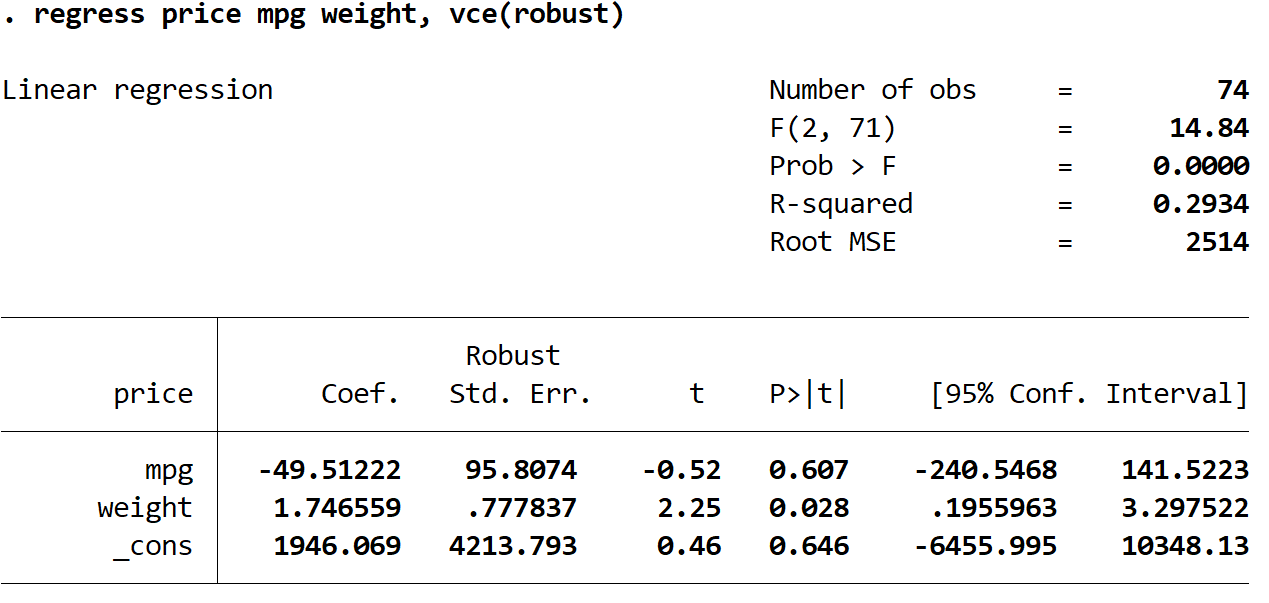
1. The Coefficient Estimates Remained Identical. The first and most crucial observation is the stability of the coefficient estimates. As expected, applying robust standard errors does not change the estimated slopes or the intercept derived from the OLS method. This confirms the mathematical property that OLS coefficients are consistent estimators even in the presence of heteroscedasticity. Notice that the coefficient estimates for mpg, weight, and the constant are exactly the same in both regressions:
- mpg: -49.51222
- weight: 1.746559
- _cons: 1946.069
2. The Standard Errors Increased Significantly. The core purpose of the robust adjustment is realized here: the standard errors associated with each coefficient estimate have been adjusted upward. For example, the standard error for mpg rose from 10.97 (OLS) to 13.06 (Robust). This increase accurately reflects the greater true uncertainty in the coefficient estimates that the standard OLS model failed to account for due to the likely presence of heteroscedasticity. This upward adjustment generally results in a more conservative inference, though it is statistically possible, in rare cases, for robust standard errors to be smaller.
3. The Test Statistic of Each Coefficient Decreased. Since the t-statistic is calculated by dividing the estimated coefficient by its standard error (Coefficient / SE), the observed increase in the standard error directly leads to a decrease in the absolute value of the t-statistic. In the robust output, the t-statistic moves closer to zero for both variables, reflecting weaker statistical evidence of a non-zero effect. This indicates that the initial OLS t-statistics were indeed inflated.
4. The P-values Increased. Following the reduction in the t-statistics, the p-values for both variables also increased. A smaller t-statistic corresponds to a larger p-value, suggesting less evidence against the null hypothesis that the coefficient is zero. While the p-value for mpg increased from 0.0000 to 0.0001 (remaining highly significant in this specific instance), the critical shift lies in the assurance that these inferential results are now founded upon sound, heteroscedasticity-consistent variance estimation, protecting the analyst from drawing unreliable conclusions.
Cite this article
Mohammed looti (2025). Learning Robust Standard Errors for Stata Regression Models: A Comprehensive Guide. PSYCHOLOGICAL STATISTICS. Retrieved from https://statistics.arabpsychology.com/use-robust-standard-errors-in-regression-in-stata/
Mohammed looti. "Learning Robust Standard Errors for Stata Regression Models: A Comprehensive Guide." PSYCHOLOGICAL STATISTICS, 8 Nov. 2025, https://statistics.arabpsychology.com/use-robust-standard-errors-in-regression-in-stata/.
Mohammed looti. "Learning Robust Standard Errors for Stata Regression Models: A Comprehensive Guide." PSYCHOLOGICAL STATISTICS, 2025. https://statistics.arabpsychology.com/use-robust-standard-errors-in-regression-in-stata/.
Mohammed looti (2025) 'Learning Robust Standard Errors for Stata Regression Models: A Comprehensive Guide', PSYCHOLOGICAL STATISTICS. Available at: https://statistics.arabpsychology.com/use-robust-standard-errors-in-regression-in-stata/.
[1] Mohammed looti, "Learning Robust Standard Errors for Stata Regression Models: A Comprehensive Guide," PSYCHOLOGICAL STATISTICS, vol. X, no. Y, ص Z-Z, November, 2025.
Mohammed looti. Learning Robust Standard Errors for Stata Regression Models: A Comprehensive Guide. PSYCHOLOGICAL STATISTICS. 2025;vol(issue):pages.