Table of Contents
Introduction to the Z-Table and the Standard Normal Distribution
The Z-Table, universally recognized as the standard normal table, is arguably the most essential reference tool in the field of inferential statistics. Its primary function is elegant yet powerful: to provide the cumulative area under the curve associated with a given data point, represented by the Z-score, within a standardized probability framework known as the standard normal distribution. This specific distribution is meticulously defined by a mean ($mu$) of zero (0) and a standard deviation ($sigma$) of one (1). The ability to transform any normally distributed dataset—regardless of its original units or scale—into this standardized framework is what makes the Z-Table indispensable. By converting raw measurements into Z-scores, we effectively quantify how many standard deviations an observation lies from the average, thereby translating raw data into terms of universal probabilities applicable across finance, engineering, psychology, and quality control.
In essence, the Z-Table serves as a translator, linking raw variability to standardized likelihood. The area listed in the table is the cumulative probability, which represents the chance that a randomly selected observation from the distribution will fall at or below that particular Z-score. Visualizing this concept is critical: the total area beneath the standard normal curve always sums to 1.0 (or 100%), encompassing all possible probabilities. Given that the standard normal curve is perfectly symmetrical around its center point (where Z=0), exactly 50% of the probability mass lies to the left of the mean, and 50% lies to the right. The Z-Table systematically maps these probabilities, typically presented with four decimal places of precision, providing the necessary statistical rigor for scientific research and economic modeling. A thorough comprehension of how to interpret this table is fundamental for anyone pursuing statistical inference or data analysis, bridging the theoretical model of distribution with practical, evidence-based decision-making.
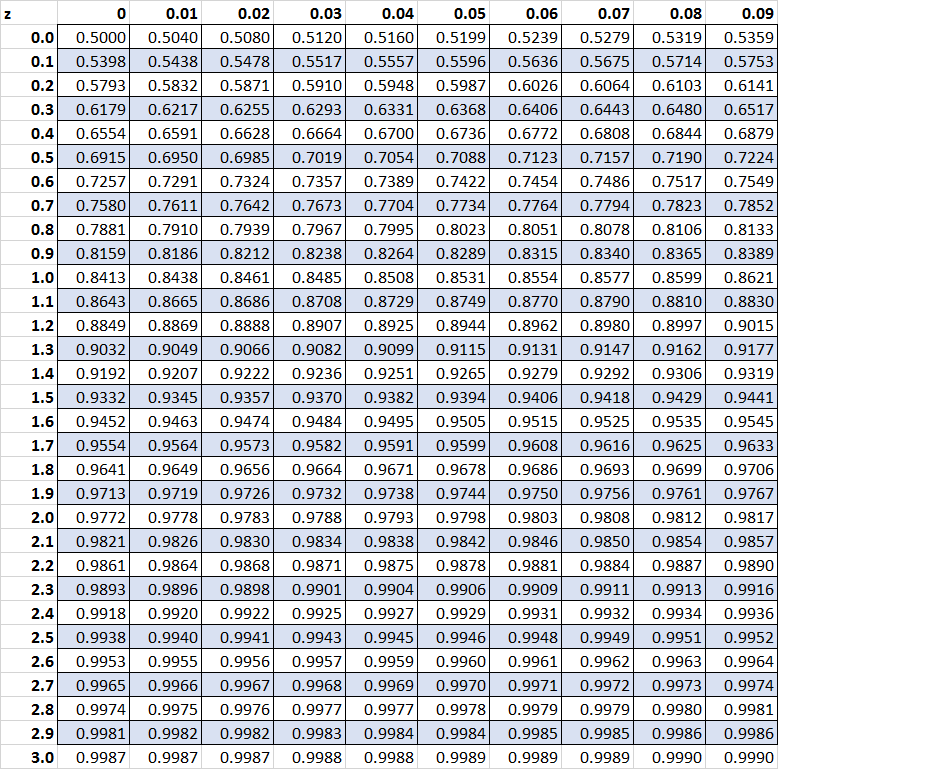
As demonstrated by the figures below, the Z-Table explicitly illustrates the proportion of the total area under the standard normal curve that exists to the left of any specified Z-value. This graphical representation confirms that the table reports $P(Z le z)$. To properly utilize this resource, one must ensure they are consulting a table that adheres to the “Area to the Left” convention, as this dictates how probabilities are calculated, especially when determining the likelihood of observations falling within a specific range or exceeding a certain threshold. The precision and consistency of these tabulated values ensure that statistical comparisons and risk assessments derived from the standard distribution are reliable and standardized globally.
The table below shows the area under the standard normal curve to the left of z.

Calculating and Interpreting the Z-Score
The prerequisite input for accessing the probabilities within the Z-Table is the Z-score itself. This score is a powerful metric that quantifies the exact number of standard deviations a raw data point (X) deviates from the population mean ($mu$). The computation of the Z-score is the foundational step in any statistical standardization process, transforming raw, often non-comparable data into a unified, standardized metric for objective analysis. The formula governing this transformation is direct and universally applied: $Z = (X – mu) / sigma$, where $sigma$ represents the population standard deviation. The sign of the resulting Z-score provides immediate contextual information: a positive Z-score confirms the observation lies above the population average, whereas a negative Z-score indicates that the observation falls below the average. For instance, a Z-score of 2.1 tells us the raw score is 2.1 standard deviations greater than the mean, providing an immediate and precise measure of its relative position within the entire dataset.
The magnitude of the Z-score is directly proportional to the extremity or rarity of the data point. Scores positioned far from zero (e.g., $Z = 3.5$ or $Z = -3.5$) reside in the tails of the distribution, signifying unusually rare observations. In contrast, Z-scores clustered close to zero represent common observations that are highly concentrated around the central tendency. This standardized measure is essential for facilitating meaningful comparisons between results derived from entirely heterogeneous studies or variables. Consider comparing a child’s height (measured in centimeters, with a certain mean and standard deviation) to their weight (measured in kilograms, with completely different parameters). Using raw scores would be meaningless; however, by converting both measurements into Z-scores, researchers can objectively determine which measurement is statistically more extreme relative to its respective population average and variability, a process crucial for achieving statistical parity when evaluating diverse data streams.
Furthermore, the Z-score is intrinsically connected to the concept of statistical significance and is central to hypothesis testing. In most inferential tests, particularly those involving large samples, the critical region used for decision-making is defined using specific Z-scores. If a researcher establishes a significance level ($alpha$) of 0.01 (meaning a 1% risk of error), they are looking for Z-scores that define the outermost 1% of the distribution. For a two-tailed test, this translates to Z-scores beyond approximately 2.58 or below -2.58. Consequently, the Z-score functions not merely as the input for the Z-Table but as the primary metric for determining whether observed results provide sufficient evidence to reject the null hypothesis, solidifying its status as a cornerstone of quantitative research methodology and decision theory.
The Systematic Anatomy of the Z-Table Lookup
To leverage the full potential of the Z-Table, one must master its systematic layout, which is engineered for efficient and accurate location of cumulative probabilities. The table deconstructs the Z-score into its necessary components for lookup: the whole number and the first decimal place are consistently found along the far-left column, while the second decimal place is indexed across the top row. For example, to determine the probability corresponding to a Z-score of 2.03, the user first locates the row labeled “2.0” in the left-hand column. They then trace this row horizontally until it intersects with the column headed by “0.03.” The numerical value at this specific intersection point is the cumulative probability, $P(Z le 2.03)$, representing the area to the left of that score.
It is vital for analysts to recognize that Z-Tables are presented in several formats, though the underlying mathematical data remains consistent. The most prevalent format, illustrated in this guide and often referred to as the “Area to the Left” table, provides the cumulative probability spanning from negative infinity up to the positive Z-score. Other variations exist, including tables that report the area between the mean (0) and Z, or those focusing only on the area in the tail (the area to the right of Z). Therefore, a statistician must always verify the specific convention used by the table they are consulting to prevent fundamental calculation errors. The inherent advantage of the cumulative probability approach is its simplicity: all other probability calculations—such as the probability of a value being greater than Z ($P(Z > z)$), or the probability of a value falling between two Z-scores ($P(z_1 le Z le z_2)$)—can be readily derived through simple subtraction, utilizing the fact that the total area under the curve is 1.
Most comprehensive Z-Tables are structurally partitioned into two distinct halves: one dedicated to negative Z-scores and the other for positive Z-scores. The negative Z-score segment typically covers probabilities from $Z approx -3.49$ up to $Z = -0.01$, encompassing the lower half of the distribution where probabilities are less than 0.5000. Conversely, the positive Z-score segment spans from $Z = 0.00$ up to $Z approx 3.49$ (or sometimes higher), covering the upper half where probabilities are 0.5000 and greater. Due to the perfect symmetry of the standard normal distribution, the probability associated with $Z = -1.50$ is the exact complement (1 minus the probability) of the probability associated with $Z = 1.50$. While some abbreviated tables rely on the user to apply these symmetry rules for negative values, full, detailed tables like those referenced here provide both sections, maximizing user convenience and minimizing calculation time.
Interpreting Tail Areas and Reverse Probability Problems
The central utility of the Z-Table lies in its ability to seamlessly convert a measure of standardized distance (the Z-score) into a measure of probability (the proportional area). When a Z-score is looked up, the resulting value is $P(Z le z)$, representing the likelihood that a randomly sampled observation will fall at or below that exact point. For instance, if the table yields 0.9987 for $Z = 3.00$, this signifies that 99.87% of all observations within that distribution fall below three standard deviations above the mean. This directly implies that the probability of observing a value greater than $Z = 3.00$ (the area in the right tail) is calculated as $1 – 0.9987 = 0.0013$, or a mere 0.13%.
A frequent requirement in statistical analysis is calculating the area between two Z-scores, a task often performed when quantifying the likelihood of a value falling within a specific, critical range, such as a confidence interval. To find the probability $P(z_1 le Z le z_2)$, the procedure is simple: locate the cumulative probability for the higher Z-score ($z_2$) and subtract the cumulative probability corresponding to the lower Z-score ($z_1$). For example, calculating the probability of a score falling within one standard deviation of the mean ($Z = -1.00$ and $Z = 1.00$) requires finding $P(Z le 1.00)$ and subtracting $P(Z le -1.00)$. This differential calculation allows researchers to precisely define the variance and central tendency likelihood, providing the necessary boundaries for accurate prediction and estimation.
Furthermore, the Z-Table is indispensable for solving “reverse” probability problems, which are common in establishing critical values. In these scenarios, the researcher begins with the desired probability (e.g., they need to find the 90th percentile) and must work backward to identify the corresponding Z-score. The user searches the main body of the Z-Table for the probability value closest to the target (0.9000 in this case). Once located, they read outward to the row and column headers to determine the precise Z-score (which is approximately 1.28). This reverse lookup capability is paramount for establishing critical values in hypothesis testing and for constructing confidence intervals, as it allows researchers to set statistical boundaries based on predetermined, acceptable levels of risk or confidence.
Core Practical Applications in Statistical Inference
The Z-Table is a foundational element in various statistical methodologies, most notably in rigorous hypothesis testing. When working with sufficiently large sample sizes (conventionally $n ge 30$) or when the true population standard deviation is known, the Z-test is employed to assess whether there is adequate statistical evidence to conclude that an observed phenomenon or treatment effect is significant. The calculated Z-statistic—which is structurally a Z-score derived from the sample mean—allows the researcher to locate the test result on the standard normal distribution. By comparing this Z-statistic to the critical Z-values derived from the Z-Table (based on the predetermined significance level, $alpha$), the formal decision to reject or fail to reject the null hypothesis is made. If the calculated Z-statistic falls into the rejection region—defined by the tail areas corresponding to the critical values—the results are declared statistically significant.
Another crucial application is the construction of confidence intervals. A confidence interval establishes a defined range of values within which the true population parameter (such as the mean) is likely to reside, coupled with a specified level of confidence (e.g., 90%, 95%, or 99%). The boundaries of these intervals are directly dependent on finding the appropriate critical Z-values using the Z-Table. For instance, creating a 95% confidence interval necessitates identifying the central 95% of the distribution, which leaves 2.5% of the area in each tail. The Z-Table quickly reveals that the Z-scores corresponding to the 97.5th percentile (0.9750 cumulative area) and the 2.5th percentile (0.0250 cumulative area) are approximately $+1.96$ and $-1.96$, respectively. These critical Z-values are then integrated into the interval formula to calculate the margin of error, unequivocally demonstrating the table’s central role in quantifying estimation precision.
Furthermore, the Z-Table is invaluable across industrial and engineering applications, especially in processes governed by the normal distribution, such as quality control. Manufacturers routinely use Z-scores to predict the likelihood of a product falling outside acceptable tolerance limits. If a manufacturing process is calibrated for a mean thickness of 50mm with a standard deviation of 0.2mm, and the maximum acceptable tolerance is 50.6mm, the corresponding Z-score is 3.0. Looking up this Z-score allows the company to determine the minute percentage of products expected to fail (the area beyond $Z=3.0$). This predictive and preventative capacity, derived exclusively from the probabilities listed in the Z-Table, enables businesses to set precise manufacturing specifications, monitor process capability indices, and drastically minimize waste, cementing its status as a critical operational metric.
Limitations, Alternatives, and the Role of Computation
Despite its immense power, the accurate application of the Z-Table is predicated upon specific statistical assumptions. Chief among these is the requirement that the underlying data must be drawn from a population that is normally distributed, or, crucially, that the distribution of sample means approximates normality—a condition often ensured by the Central Limit Theorem when the sample size is large (typically $n ge 30$). If the population distribution is severely non-normal or highly skewed, and the available sample size is small, utilizing the Z-Table can lead to highly inaccurate probability estimates and potentially flawed statistical conclusions. Therefore, confirming the distributional characteristics of the data through visual inspection or formal testing is a necessary precondition before employing Z-score methodology.
The most common and significant limitation arises when the population standard deviation ($sigma$) is unknown, which is frequently the situation in real-world research. When $sigma$ must be estimated using the sample standard deviation ($s$), the appropriate reference distribution shifts away from the standard normal (Z) distribution to the Student’s t-distribution. The t-distribution inherently accounts for the added uncertainty introduced by estimating the population standard deviation from a sample, and its specific shape is dependent on the degrees of freedom ($df = n – 1$). In such circumstances, the Z-Table must be replaced by the T-Table. The T-Table provides critical values that are generally wider (more cautious) than their Z-counterparts, particularly for small sample sizes, reflecting the greater variability and uncertainty inherent in estimating $sigma$.
Furthermore, contemporary statistical practice has significantly reduced the reliance on physical tables through the widespread use of computational software. Modern statistical packages (such as R, Python libraries, SPSS, or advanced calculators) can instantaneously calculate the cumulative probability for any Z-score (or determine the Z-score for a given probability) with precision often exceeding the four decimal places provided by printed tables. While these software tools automate the lookup and interpolation process, the fundamental conceptual understanding derived from the Z-Table remains paramount. Analysts must still grasp that the software executes the exact same core task—determining the area under the density curve—even if the manual lookup step is bypassed. Consequently, the Z-Table retains its essential role as a pedagogical tool, clearly illustrating the core statistical relationship between standardized scores and probability.
Conclusion: The Enduring Significance of the Z-Table
The Z-Table transcends its identity as a simple collection of numerical values; it functions as a critical mathematical bridge, connecting raw empirical data to rigorous statistical probability within the robust framework of the standard normal distribution. By standardizing diverse datasets using the transformative Z-score, this table empowers statisticians and researchers to effectively quantify uncertainty, compare statistically distinct results objectively, and formulate sound, data-driven inferences about underlying populations. Whether employed manually for educational clarity or conceptually understood as the computational basis for automated software, its core principle is unwavering: the Z-Table provides the essential cumulative area under the curve to the left of any specific standardized point, $P(Z le z)$.
The highly organized and systematic layout of the table, which permits rapid lookup based on the Z-score’s row (whole number and first decimal) and column (second decimal), ensures its practical utility across diverse scientific and economic fields requiring high-precision probabilistic assessments. From establishing statistical significance in complex hypothesis testing scenarios to defining the precise boundaries of confidence intervals, the Z-Table furnishes the critical values necessary for informed statistical decision-making. While alternatives such as the T-Table are necessary for specific situations (e.g., small samples or unknown population variance), the Z-Table remains the foundational reference for probability calculations involving the most pervasive distribution in statistical science.
Ultimately, a profound understanding of the Z-score calculation, the inherent symmetry of the standard normal curve, and the accurate interpretation of the cumulative probabilities derived from the Z-Table equips any analyst with the necessary statistical literacy to navigate and contribute effectively to quantitative research. The comprehensive data presented in the included images visually reinforces this invaluable tool, demonstrating the full scope of information required to cover both the negative and positive Z-scores encountered in real-world statistical analysis.
Cite this article
Mohammed looti (2025). Learning to Use the Z-Table: A Step-by-Step Guide to Standard Normal Distribution Probabilities. PSYCHOLOGICAL STATISTICS. Retrieved from https://statistics.arabpsychology.com/z-table/
Mohammed looti. "Learning to Use the Z-Table: A Step-by-Step Guide to Standard Normal Distribution Probabilities." PSYCHOLOGICAL STATISTICS, 9 Nov. 2025, https://statistics.arabpsychology.com/z-table/.
Mohammed looti. "Learning to Use the Z-Table: A Step-by-Step Guide to Standard Normal Distribution Probabilities." PSYCHOLOGICAL STATISTICS, 2025. https://statistics.arabpsychology.com/z-table/.
Mohammed looti (2025) 'Learning to Use the Z-Table: A Step-by-Step Guide to Standard Normal Distribution Probabilities', PSYCHOLOGICAL STATISTICS. Available at: https://statistics.arabpsychology.com/z-table/.
[1] Mohammed looti, "Learning to Use the Z-Table: A Step-by-Step Guide to Standard Normal Distribution Probabilities," PSYCHOLOGICAL STATISTICS, vol. X, no. Y, ص Z-Z, November, 2025.
Mohammed looti. Learning to Use the Z-Table: A Step-by-Step Guide to Standard Normal Distribution Probabilities. PSYCHOLOGICAL STATISTICS. 2025;vol(issue):pages.